Know what every dish costs you from your first week
Opening a restaurant means learning to cook with numbers at the same time as with fire. Teremu reads your supplier invoices with your phone camera and keeps the cost of every dish on your menu current, with no manual data entry.
Free forever: 25 scans a month, no card, nothing to install at your place.
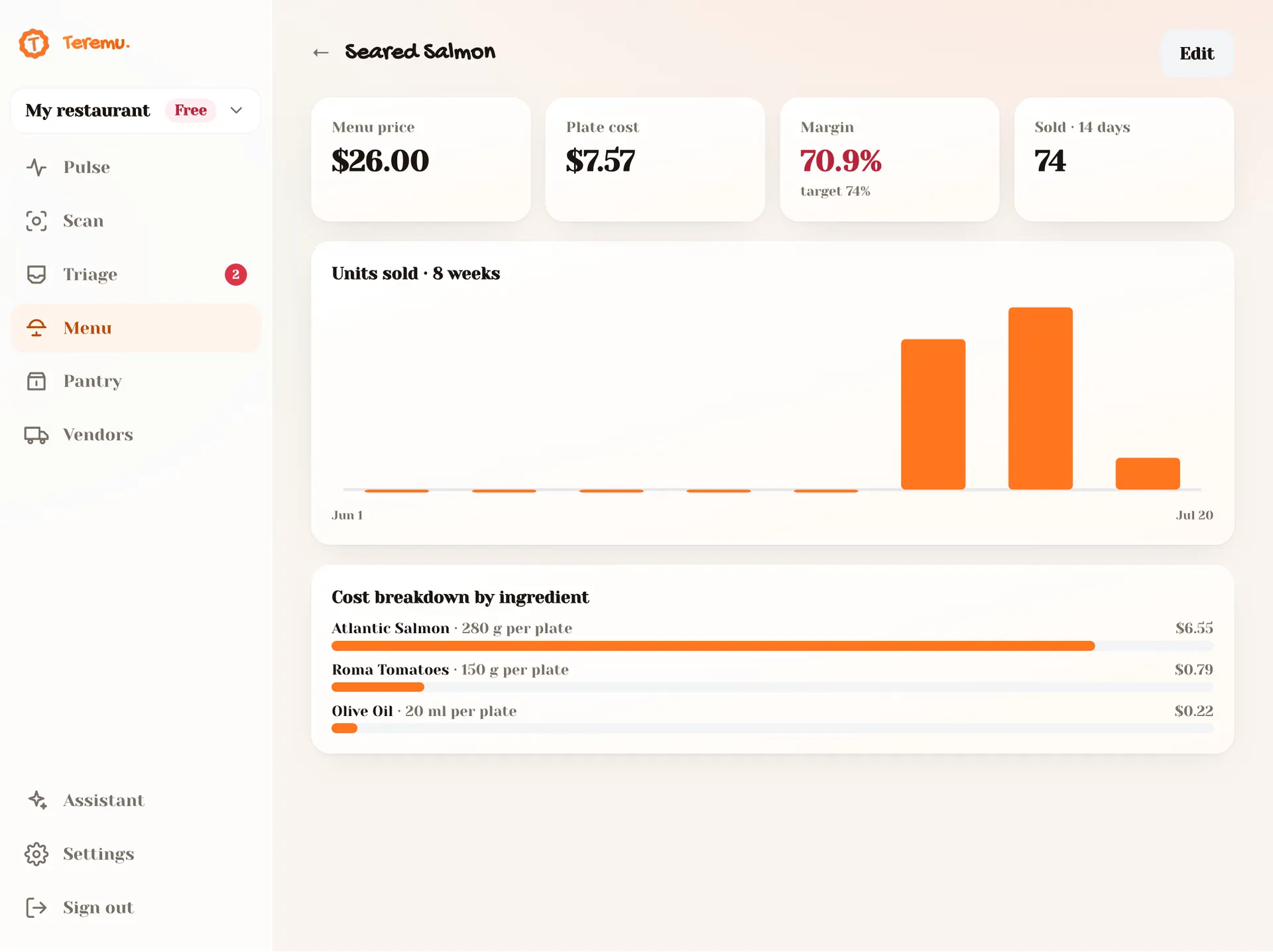
The numbers that slip when you’re starting out
A menu costed once
You ran the numbers before opening and set your prices. Since then proteins, oil and produce have all changed price, and the menu has not.
Invoices nobody checks
Each supplier's invoice arrives with the delivery and ends up in a drawer. If you were overcharged or a price went up, you find out late or never.
Busy, but are you making money?
The dining room is full, but at the end of the month the money does not add up. Without your real food cost, you cannot tell if the problem is the menu, the purchasing or the overhead.
Your costing system, from your phone
Scan your invoices
Snap a photo of the invoice, even a crumpled one, or upload the PDF. AI reads the supplier, items, quantities and prices.
Review and approve
In Triage you confirm what the AI read before it counts. If the delivery note and the invoice do not match, you see it there.
Weekly food cost
Pulse shows your weekly spend and food cost against the 28% to 35% band many restaurants use as a reference.
Dishes at risk
When a supplier raises a price, Teremu alerts you to the dishes that fell below your target margin, worst first.
Your first week with Teremu
- 1
Day 1: create your free account with Google and scan the invoices from your latest order with each supplier.
- 2
Day 2: add your 10 best-selling dishes with their ingredients and quantities per plate.
- 3
Day 3: check each dish's cost and margin and set the target margin you want.
- 4
Day 4 onward: scan every invoice as it arrives. Dish costs, weekly food cost and alerts update on their own.
How to calculate the cost of a dish
A dish's cost is the sum of what each ingredient costs in the amount you serve. It takes three steps:
- Unit price of each ingredient. Divide what you paid by what you bought: a 40 lb case of chicken breast at $160 costs $4.00 per pound.
- Cost per plate. Multiply the amount on the plate by that price: 8 oz of chicken is $2.00. Add every ingredient, including oil, sides and sauce.
- Cost percentage. Divide the plate cost by the menu price. A dish that costs $2.86 and sells for $10 runs a 28.6% cost.
Start with your best sellers. They carry the most weight in your results.
The number to check every week
Plate cost tells you whether the menu is designed well. Weekly food cost tells you whether the operation is living up to it. Calculate it as beginning inventory plus purchases minus ending inventory, divided by the week's sales. If it climbs without any menu change, something is going on: a supplier raised prices, there is waste or portions are creeping up.
Teremu takes purchases from your scanned invoices and shows your weekly spend and food cost in Pulse, no spreadsheet needed.
What to watch in a new restaurant
- Proteins: beef, chicken and seafood are usually the most expensive part of the plate and the most volatile in price.
- Best sellers with thin margins: one dish that sells a lot and earns little can matter more than ten that hardly anyone orders.
- Invoice errors: quantities that never arrived or prices that differ from what you agreed. Check each invoice against what you received.
- Menu prices: if you do not review them every few months, each supplier increase comes straight out of your profit.
Guides to keep learning
What numbers should a new restaurant track from day one? (with examples)
The five numbers every new restaurant should calculate: plate cost, weekly food cost, prime cost, average check and break-even. With formulas, a worked example and how to keep them current.
How to calculate your restaurant's food cost (no spreadsheets)
A practical guide to calculating food cost percentage, understanding the healthy 28–35% range, and spotting the dishes that are eating your margin.
Frequently asked questions
How do I calculate food cost for my restaurant?
Food cost % = (beginning inventory + purchases − ending inventory) ÷ sales × 100. If you used $4,800 in ingredients in a week and sold $15,000, your food cost is 32%. For a single dish, divide its ingredient cost by its menu price.
What is a healthy food cost for a restaurant?
It depends on the concept, but many restaurants aim for a food cost of roughly 28% to 35% of sales. What matters is measuring yours every week and watching which way it moves.
Do I need a POS system to use Teremu?
No. Teremu works from your invoices, not your sales, so it runs without a POS. You use it on your phone (iOS and Android) or in the browser.
Can my team use it?
Yes. On Pro ($39 per location per month) up to 5 people can join, and on Max ($59 per location per month) up to 10, each with permissions for what they need to see or do. The Free plan is for the owner as the only user.
Do I have to hand over my full recipes?
No. Teremu only needs the ingredients and quantities in each dish to cost it, never the method. Your recipes stay yours.
Teremu is also for
Know what you make on every sale
Scan your first invoice today. No spreadsheets, no data entry, no card.